
Agile Communication for Singapore Client Projects: Make Decisions Traceable
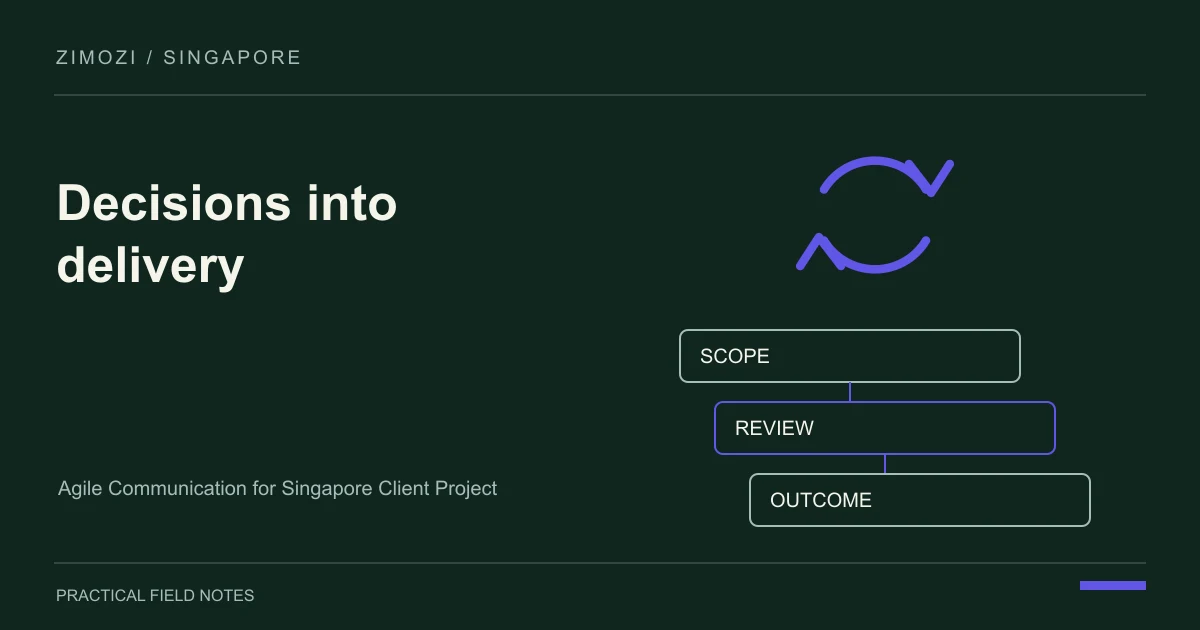
Agile communication works when a delivery team can explain what changed and who accepted the consequence. A Singapore SME commissioning software may have an owner, operations lead and external engineering partner all giving feedback through different channels.
Without a decision trail, frequent meetings can still produce contradictory work. This article focuses on the practical communication contract between client and team: a clear goal, visible acceptance conditions and a place for unresolved choices.
You will learn how to turn feedback into decisions without asking every stakeholder to attend every conversation. The result should be less ambiguity about the next release, not more ceremony around an unchanged backlog.
In this guide
- Which information needs a durable record?
- How should demonstrations change the plan?
- What does coordination cost?
- What makes a team appear busy but remain blocked?
- Decision checklist
- FAQ
- Further reading
Which information needs a durable record?
Record the intended user outcome, accepted behaviour and unresolved constraints beside the work item. A hypothetical booking project may distinguish a request from a confirmed reservation.
If a stakeholder changes that meaning during a demonstration, update the acceptance conditions and identify affected messages, reports and staff procedures. A chat reaction is not a sufficiently clear record of that decision.
How should demonstrations change the plan?
Demonstrate a usable journey using realistic inputs, including failure cases. Ask the client to explain whether the outcome fits actual operations.
Separate defects from new requirements and preferences. The Agile principles value working software and collaboration; they do not remove the need to make trade-offs explicit.
Keep a short decision note when feedback changes cost, timing or scope.
What does coordination cost?
Reserve time for a product owner to answer questions and accept completed work. A vendor cannot compensate for absent business decisions by scheduling more stand-ups.
Establish a response route for urgent blockers and a regular review for lower-priority requests. Publish a release note that operations staff can understand before the change reaches customers.
What makes a team appear busy but remain blocked?
Avoid measuring progress by ticket volume or treating every suggestion as an immediate commitment. Unanswered questions should be visible work, with an owner and consequence.
Otherwise the team may repeatedly build around an assumption nobody approved.
Decision checklist
- Record the intended user outcome, accepted behaviour and unresolved constraints beside the work item.
- Demonstrate a usable journey using realistic inputs, including failure cases.
- Reserve time for a product owner to answer questions and accept completed work.
FAQ
Does Agile require a daily client meeting?
No. Agree a cadence that resolves decisions without interrupting everyone unnecessarily.
Who should prioritise the backlog?
An accountable business owner should make priority trade-offs with input from delivery specialists.
Can scope change during delivery?
Yes, but affected acceptance conditions and expectations must change with it.
What belongs in a decision log?
The choice, rationale, owner and consequences that future contributors need to understand.
Is documentation contrary to Agile?
Useful records support collaboration when they help people build and operate the right thing.
Further reading
Technical reference: Principles behind the Agile Manifesto. The scenarios above are illustrative, not client case studies.
Related articles: A UI/UX Process for Singapore Internal Tools: Design Around Exceptions and Web Applications for Singapore SMEs: Replace One Broken Handoff First.