
Designing a Mileage Approval Workflow for Singapore Employers
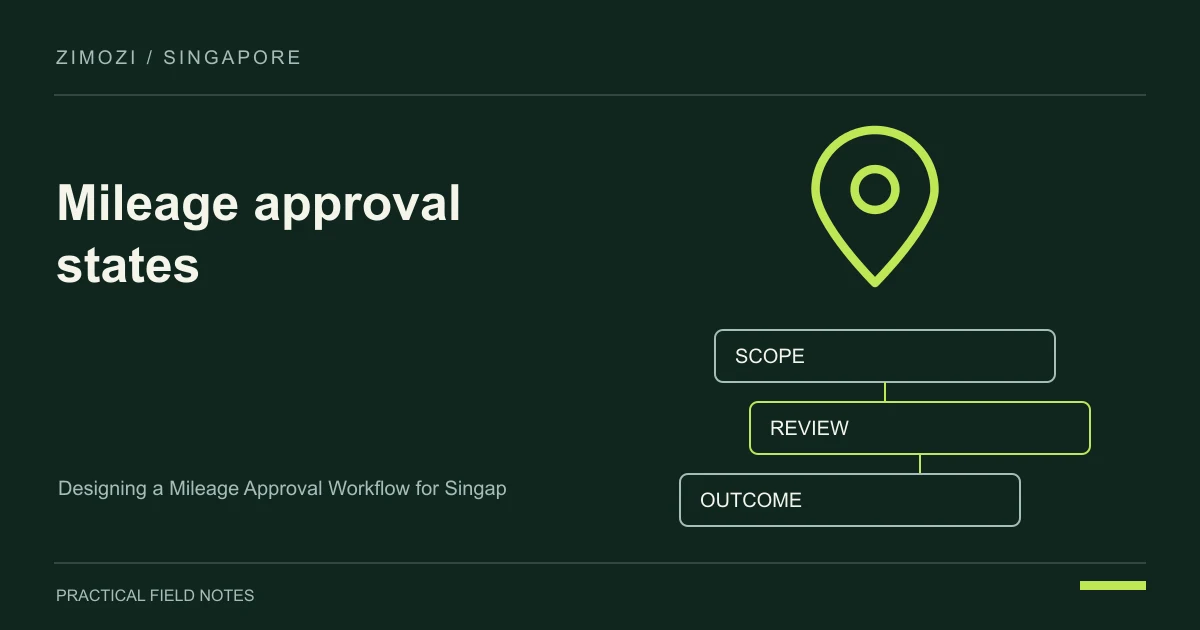
A mileage claim needs a clear route from employee entry to an authorised decision. A tracking tool alone cannot decide whether a trip meets an employer's policy, which job should bear the cost or how a correction should be recorded.
This guide focuses on that approval workflow for Singapore businesses with visiting staff. It is distinct from continuous fleet monitoring and does not prescribe tax treatment or reimbursement rates.
Using a hypothetical inspection team, you will define the claim record, review states and exception handling needed to reduce clarification emails while keeping decisions explainable to employees, supervisors and the finance team responsible for processing approved claims.
In this guide
- What makes a claim reviewable?
- How should approval states work?
- What does deployment require?
- Which automation choices should remain limited?
- Decision checklist
- FAQ
- Further reading
What makes a claim reviewable?
Capture the business purpose, trip date, job or customer reference and the distance basis required by the approved policy. Make the policy version visible where it affects the claim.
An inspection visit that was cancelled after travel may need an explanation, not automatic rejection. Keep supporting records proportionate to the review purpose rather than collecting unrelated personal movement.
How should approval states work?
Use draft, submitted, returned, approved and processed states with clear ownership. A supervisor's approval should not imply that finance has paid the claim.
When an employee corrects a returned item, preserve what changed and why. Prevent a repeated submission from creating another payable record, and allow authorised reviewers to identify related claims without editing history silently.
What does deployment require?
Agree the policy and authority matrix before configuring the application. Test leave cover, a changed supervisor and a disputed distance.
Include employee guidance and finance export reconciliation in the rollout budget. A successful pilot should demonstrate that staff understand returned items and that approved records arrive in the next system without duplicate or missing entries.
Which automation choices should remain limited?
Do not treat GPS distance as an unquestionable policy decision or auto-approve every entry below an arbitrary amount. Keep policy interpretation and exceptional decisions accountable to authorised staff.
Clear reasons for returns are more useful than a generic rejected status.
Decision checklist
- Capture the business purpose, trip date, job or customer reference and the distance basis required by the approved policy.
- Use draft, submitted, returned, approved and processed states with clear ownership.
- Agree the policy and authority matrix before configuring the application.
FAQ
Is this a reimbursement policy?
No. The application should implement a policy the employer has already reviewed and approved.
Should approval and payment share one status?
No. They represent different decisions and should be distinguishable.
Can a returned claim be corrected?
Yes, with a visible change history and a route back to review.
What happens when a manager is absent?
Use an authorised delegation process rather than sharing accounts or bypassing review.
How should duplicate claims be handled?
Flag related entries for review and prevent repeated processing of the same approved record.
Further reading
Technical reference: MDN Geolocation API reference. The scenarios above are illustrative, not client case studies.
Related articles: Mileage Tracking for Singapore Service Fleets: Connect Trips to Jobs and Planning a Mobile App for Singapore Service Operations.